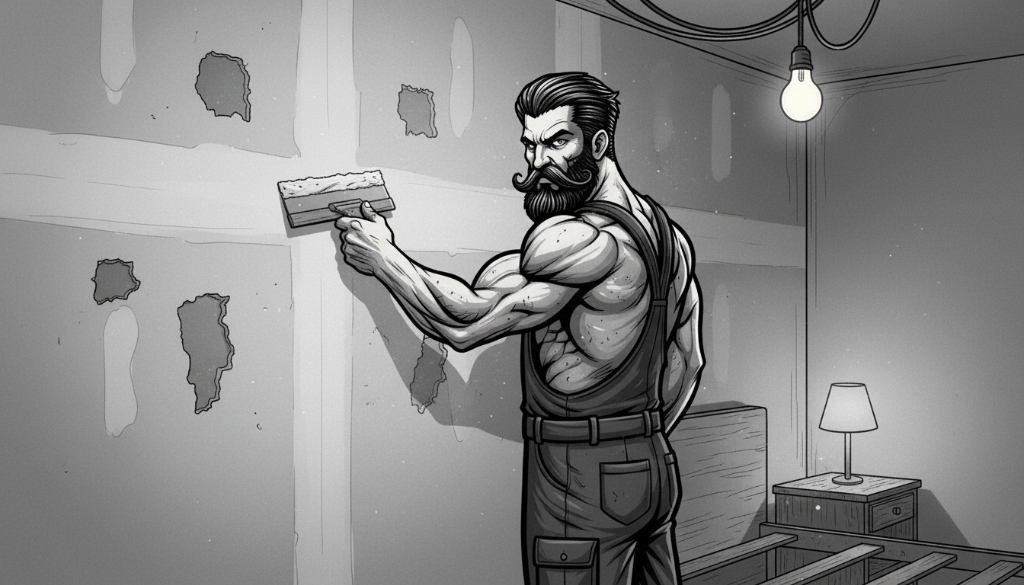
Drywall cracks in Grande Prairie are usually seasonal movement from a sixty degree annual temperature swing. Water stains mean a leak you need to find before you patch. Nail pops are cosmetic. Horizontal cracks at mid height on exterior walls can mean truss uplift or foundation shift. A proper patch with tape, mud, and texture match runs three hundred to eight hundred dollars for a typical repair. Bigger problems need a look before we quote.
Why Do Cracks Show Up Every Spring and Fall
Grande Prairie sits in a climate zone where the air temperature swings from minus thirty five in January to plus twenty five in July. That sixty degree spread moves everything. Wood framing shrinks and swells. Trusses lift. Concrete footings heave. The drywall screwed to that framing takes the stress and cracks at the weak points.
You will see the same cracks open and close on a yearly cycle. Vertical cracks at inside corners. Diagonal cracks off window and door headers. Nail pops where the framing moved and the fastener head pushed the mud. These are cosmetic. They happen in every house in the Peace Country. The fix is cut out the loose mud, retape, three coats of compound, sand, prime, and texture match.
What makes it worse here is the long dark winter. Houses stay closed up. Humidity drops. Framing dries out and shrinks more. Then spring melt brings moisture back. The cycle repeats. If you patch in January with the house at its driest, the crack will be tight. Come July the joint works loose again. We time major tape jobs for shoulder seasons when the house is closer to its middle moisture content.
Which Cracks Are Just Cosmetic and Which Mean Trouble
Not every crack is harmless. Here is how to tell the difference.
- Vertical hairline at inside corners. Seasonal. Harmless. Retape and move on.
- Diagonal off window and door corners. Usually framing movement. Cosmetic if they stay hairline and do not widen year over year.
- Nail pops in a line across a ceiling or wall. Framing shrinkage. Cosmetic. Drive a new screw beside each pop, dimple the old one, mud over both.
- Horizontal crack at mid height on an exterior wall. This one pays attention. It can mean truss uplift where the bottom chord of a roof truss arches up in winter. It can mean foundation heave from frost. If the crack is wider at one end, or if doors stick in that room, get it looked at.
- Stair step crack following drywall joints up a wall. Can be normal settlement in a newer house. In an older house it can mean ongoing movement. Mark the ends with pencil and date. Check in six months.
- Crack wider than a quarter inch or growing fast. Structural until proven otherwise. Call someone who reads foundation movement.
We see a lot of truss uplift in newer subdivisions around Westpointe and Crystal Heights where engineered trusses sit on interior partition walls. The bottom chord lifts in cold dry winters and pushes the interior wall up. The drywall cracks at the ceiling line. The fix there is not more mud. It is installing truss clips or sliding connections so the partition wall can float. That is a framing repair, not a drywall repair.
Water Stains on the Ceiling: Find the Source First
A brown ring on the ceiling is not a drywall problem. It is a roof problem or a plumbing problem or a condensation problem. Painting over it guarantees you do it again in six months.
In Grande Prairie the usual suspects are ice dams on low slope roofs, blown flashing at plumbing stacks, and bathroom exhaust fans vented into the attic instead of out the roof. We also see condensation stains in vaulted ceilings where the vapour barrier was missed or torn during the build. Warm moist air hits the cold roof deck and drips back down.
Before we touch the stain we go in the attic. We look for wet insulation, frost on the sheathing, stained framing, daylight at penetrations. If the roof is the issue you need a roofer. If it is a bath fan we reroute the duct and add a proper roof vent. If it is condensation we address ventilation and vapour barrier. Only then do we cut out the stained drywall, treat any mould, and patch.
Cost for a stain patch after the leak is fixed runs two hundred fifty to five hundred dollars depending on ceiling height and texture. Cost for ignoring it and letting rot set in runs into thousands for sheathing and framing replacement.
What a Proper Patch Actually Involves
Homeowners think patching is slapping mud in a hole. A patch that disappears takes five steps and two days minimum.
- Cut back to solid. We cut a rectangle or square around the damage to expose half a stud on each side. Round holes leave weak edges that crack again.
- Backer board. For holes wider than six inches we screw wood backers behind the opening so the new drywall has something to fasten to.
- Hang the patch. Same thickness drywall. Screws every twelve inches. No butt joints if we can avoid them.
- Tape and three coats. Paper tape for strength. Mesh only for tiny repairs. First coat beds the tape. Second coat fills and feathers. Third coat is a wide skim for blending. Each coat dries twenty four hours in our climate. Heat and fans help but you cannot rush the chemistry.
- Texture match. This is where most DIY and cheap jobs fail. Orange peel, knockdown, popcorn, stomp brush. Each needs the right hopper pressure, mud consistency, and technique. We spray a test board first. If the match is off we adjust. The ceiling gets painted corner to corner so the sheen matches.
Skip a step and the patch shows in raking light. Every time. That is why a three hundred dollar patch looks invisible and a fifty dollar patch looks like a patch.
What It Costs in Grande Prairie Right Now
Every job is different but here are real ranges we see for standard residential work.
- Single nail pop or screw pop repair. Eighty to one hundred fifty dollars. Minimum trip charge applies.
- Small hole up to six inches. Two hundred to three hundred fifty dollars.
- Medium hole or crack repair one to three feet. Three hundred fifty to six hundred dollars.
- Full ceiling retape and texture in a bedroom. Eight hundred to fifteen hundred dollars depending on texture type and ceiling height.
- Water stain patch after leak repair. Two hundred fifty to five hundred dollars plus the leak fix.
- Texture match only on a patched area. One hundred fifty to three hundred dollars.
Factors that move the price: vaulted ceilings need scaffolding. Popcorn removal and retexture adds labour. Lead or asbestos testing in homes built before nineteen ninety adds cost and time. Matching a custom texture can take two trips. We give a firm quote after seeing it. Call Jeff at 780-835-1444 and we will look at it.
DIY Where It Makes Sense. Call Us Where It Does Not.
Grande Prairie has a strong DIY culture. Guys here work oilfield rotations and have two weeks on two weeks off. They want to tackle things themselves. Here is the line.
- Do it yourself: Nail pops. Small holes from picture hooks or door handles. Hairline cracks at corners you can reach. Touch up paint on flat ceilings.
- Call us: Anything over a foot wide. Anything on a vaulted ceiling. Texture match on knockdown or popcorn. Water stains where you have not found the leak. Horizontal cracks on exterior walls. Any repair where you need scaffolding or a ladder over eight feet.
The mud is cheap. The tape is cheap. The tools are not. A decent twelve inch knife, a hawk, a pole sander, a texture hopper and compressor run six hundred dollars used. Your time on a rotation is worth more. We bring the gear, we know the local textures, and we clean up. That is the value.
If you patch a water stain without fixing the leak you are not saving money. You are buying time until the rot shows in the framing. Find the water first. Patch second.
Permits and Inspections for Drywall Work
Simple drywall repair does not need a permit in the City of Grande Prairie or the County. You are not changing structure, egress, or fire separation. If you are opening walls for electrical, plumbing, or moving a load bearing wall, that triggers a permit. The City issues permits through their Building Safety Codes office. The County uses Parkland Safety Codes. We coordinate with the inspector when the work calls for it. You do not need an engineer sign off for a patch. You do need one if you are removing a beam or changing a truss.
Seasonal Timing Matters Here
Best time for big tape jobs is late April through June or September through October. The house has stabilized. Humidity is moderate. Mud dries predictable. Winter works for small patches if the heat is on and the house is at normal occupancy humidity. July and August can be tricky. High heat and low humidity flash dry the mud. You get pock marks and weak bonds. We retard the mix or work early mornings. If you want a whole ceiling redone book the shoulder season. The schedule fills fast when the weather turns.
Bottom line. Drywall cracks in this town are mostly the house breathing. Water stains are a leak. Horizontal cracks on outside walls need a second look. A real patch takes two days and the right texture gear. We do this work every week across the Peace Region from Clairmont to Beaverlodge. Our renovation crew handles the patch. Our handyman side handles the smaller stuff. Text or call and we will look at it.
Frequently Asked Questions
Why do my drywall cracks open every winter and close every summer?
Grande Prairie swings sixty degrees annually from minus thirty five to plus twenty five. Wood framing shrinks in the dry cold and swells in the humid heat. The drywall screwed to that framing cracks at the weak points. It is normal seasonal movement in this climate.
How do I know if a ceiling crack is truss uplift or foundation trouble?
Truss uplift usually shows as a horizontal crack at the ceiling line on interior partition walls mid house. It often opens in winter and closes in summer. Foundation cracks tend to run diagonal from corners of openings or vertical on exterior walls and they do not fully close. Mark the ends with pencil and date. Check in six months.
Can I just paint over a water stain with stain blocker primer?
You can but the leak will still be there. The stain will bleed through again and the wet insulation or sheathing will rot. Find and fix the roof leak, plumbing leak, or condensation source first. Then cut out the stained drywall, treat any mould, and patch properly.
What does it cost to retape and texture a standard bedroom ceiling in Grande Prairie?
Eight hundred to fifteen hundred dollars depending on ceiling height, texture type, and whether we need scaffolding. Popcorn removal and retexture adds labour. Vaulted ceilings add setup time. We quote firm after seeing the room.
Is mesh tape okay for all drywall repairs?
Mesh tape is fine for small holes and non structural cracks. Paper tape is stronger for butt joints, long seams, and areas that move. We use paper tape for any repair over a foot long or on ceilings where truss uplift or framing movement happens.
Do I need a permit to patch drywall in the County of Grande Prairie?
No. Simple drywall repair and patching does not require a permit in the City or the County. Permits are triggered when you alter structure, electrical, plumbing, or fire separations. If you are just patching holes, cracks, or stains, no permit needed.
Get It Done Right The First Time.
Renovations, repairs, and builds across Grande Prairie and the Peace Region, done by a crew that shows up and finishes. See our recent work or get a free estimate.
Get A Free Estimate